

UK youth employment crisis: A perfect storm for graduates
This blog is based on an article originally published on the website of Adzuna, one of the largest online job search engines in the UK.
The UK labour market faces unprecedented challenges with unemployment, particularly for young workers and graduates. Almost one million young people (957,000) are not in education, employment or training – a rise of 259,000 between 2021-2024 alone. What emerges is a troubling picture of declining opportunities, structural shifts, and a generation at risk.
The demand collapse
The UK labour market has experienced a persistent downward trend in job demand over the last three years. Most strikingly, graduate positions have plummeted. In 2025 alone graduate positions were reduced by 33%, reaching the lowest level since 2018. This marks the second consecutive year of decline, creating fierce competition as previous cohorts continue struggling to find suitable employment. The Resolution Foundation has reported that job mobility rates (i.e. the share of workers who moved jobs per quarter) are now lower than in the 1980s, signalling a fundamental shift in labour market dynamics.
Industry analysis: The paradox of rising salaries
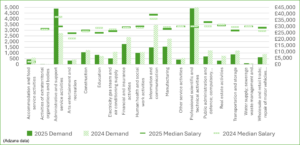
Data from the Adzuna intelligence portal reveals a troubling paradox across major industries between 2024 and 2025. The data allows us to examine the demand in graduate job roles across major industrial sectors along with the median salary offered in these sectors. According to the job advertisement data between 2024 and 2025 the median salaries have increased in industries associated with the following sectors: arts entertainment and recreation, human health and social work, information and communication, the broader public administration activities (including defence), and wholesale/retail. However, in each of these industries demand has decreased; and on some occasions, like the Information and communications sector, it has decreased substantially.
Figure 1. Demand and Median Salaries for graduate jobs across major industries
Graduate outcomes: underemployment epidemic
The UK graduate statistics paint a sobering picture:
- Just 61% of 2022 graduates secured full-time work 15 months after graduation, with many in non-graduate roles.
- According to the ONS records, only 60.1% of graduates aged 21-30 in England work in “high-skilled” positions.
- Approximately 16% of graduates are in medium or low-skilled employment.
- 13.9% of graduates are out of work.
As the CIPD highlighted in their 2024 report, three decades of higher education expansion has led to “a growing number of graduates [entering] occupations where a degree is not necessary”. Young people delay labour market entry to pursue degrees, only to find themselves competing for roles that don’t require their qualifications.
The AI factor: displacement and discouragement
Artificial intelligence represents a disproportionate threat to youth employment. Young workers concentrate in sectors with highly automatable tasks, making them particularly vulnerable to displacement or augmentation. The psychological impact is profound: more than one in four young people report avoiding job applications or courses because they fear AI will replace those roles. Whether these fears prove accurate or not, the discouragement itself creates negative implications for future employment potential.
Recent research on the “agentic economy” suggests AI agents could eliminate the need for intermediary platforms entirely. The jobs market is witnessing a “double squeeze” of economic stagnation (leading to employer caution) and the rapid integration of generative AI that seems to be automating some of the entry-level tasks traditionally used to train new workers. Until economies expand and create demand for new skills and expertise, the market will likely continue to face a volatile period of suppressed hiring. Alarmingly, only 13% of graduate schemes include AI training, leaving young workers unprepared for the very technology reshaping their career prospects.
Current Employment Reality
The ONS March 2026 employment data show:
- 3.84 million young people aged 16-24 in employment
- Youth employment rate of just 51.3%
- Unemployment rate for 18-24 year-olds at 14.5%, up from 12.9% in 2024
These figures likely underestimate the crisis, as they don’t capture everyone out of work or reflect the quality of available opportunities.
The mental health crisis
Mental health has emerged as both a cause and consequence of youth unemployment, creating a vicious cycle. The Youth Employment 2024 Outlook found that 85% of young people with mental health conditions believe it affects their ability to find or function in work. The Resolution Foundation notes that one-third of 18-24 year-olds report having a common mental disorder, rising to two-fifths among young women. This crisis threatens to create what researchers term a “lost generation”. In February 2026, ONS reported that the number of economically inactive aged 16 to 24 years who were NEET was at an estimated 957,000 young people, up from 946,000 in July to September 2025. Recent data shows that the overall number of disabled people aged 16-24 years not-in-employment was at 843,792 , which is an increase of 42% since 2013/14.
Policy response and future directions
The UK’s Get Britain Working white paper and Youth Guarantee initiative represent important first steps. The recent DWP announcement of £1 billion subsidies and grants for apprenticeships aimed at closing the skills gap and supporting more NEET young people into meaningful employment. However, addressing this multifaceted crisis requires comprehensive action:
Immediate priorities:
- Fund “AI Skilling Hubs” in areas beyond major urban centres to prevent widening regional divides.
- Implement continuous upskilling schemes aligned with evolving AI-era needs.
- Consider “human-centric” tax credits encouraging companies to retain staff.
- Provide significant support for mid-career retraining.
The youth employment crisis reflects converging forces: cyclical economic uncertainty, structural AI-driven disruption, inadequate skills preparation and a devastating mental health epidemic. Without urgent comprehensive intervention across education, technology policy, mental health support and economic strategy, we risk condemning an entire generation to diminished prospects and unfulfilled potential.
Moreover, as labour-based tax revenue declines, governments may need to pivot toward higher VAT or specific taxes on “automated transactions” executed by AI agents. Pressure for Universal Basic Income or similar schemes will likely increase to support populations during this “hiring stall”. The data is clear: young people face not just a difficult job market, but a fundamentally transformed landscape requiring radical policy innovation to ensure their futures.
Any views expressed are those of the author and not necessarily those of the Institute as a whole.