

Potential to Progression: measuring the impact of Realising Opportunities on Higher Education access
Realising Opportunities (RO) is a higher education (HE) outreach programme aimed at the ‘most able, least likely’ students in Key Stage 5 (KS5) – students with good academic attainment, from backgrounds that are associated with lower than average access rates to HE – to raise their aspirations to apply to a university in general, and a research intensive university (RIU) in particular. Eligibility for free school meals, living in local areas with high material disadvantage and living in areas with low access rates to HE, are among the disadvantage indicators used to determine eligibility for the programme.
A dataset linking pupil data with HE records was obtained from the Department for Education to develop a counter-factual comparator group for RO students – those with similar academic records and meeting some of the disadvantage characteristics, from local areas in which RO operates but not participating in the programme – against whom the impact of RO on HE access can be measured.
The analysis was undertaken on students who entered Key Stage 5 from 2011 to 2015, corresponding with RO Cohorts 3 to 7. During this period, the HE access rate for RO students dipped in Cohort 5, while in the other four cohorts it was around 65–70%. RO students were on average more disadvantaged than students in the comparator group – more likely to be eligible for free school meals, or to live in areas with both high material disadvantage and low HE access rates.
For all cohorts except Cohort 5, the immediate HE access rates for RO students were higher than for the comparator group, and these differences were statistically significant at the 5% level (at least) using the Z-test for proportions. This pattern was repeated when looking at the access rate after two years.
The analysis also considered access to RIUs, and two measures were considered here – the proportion of students accessing RIUs as a proportion of all students, and as a proportion of those accessing HE in general. On the first measure, the RIU access rates of RO students were significantly higher than the comparator group in Cohorts 3, 6 and 7, while on the second measure the rate was higher for RO students in Cohorts 3 and 7.
IES has developed an infographic to summarise the findings (below, and downloadable on the right):
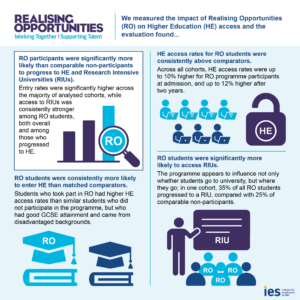 |
The findings indicate that RO participation positively impacts on students’ access rates to HE generally and RIUs in particular, therefore the programme is meeting its aim of increasing access for participating students. These results also support those from an alternative analysis of the impact of RO, based on a model of the factors influencing university access across all students and entering the details of RO students into the model parameters. This alternative analysis found a significantly higher access rate for RO students than for the population of all students.