
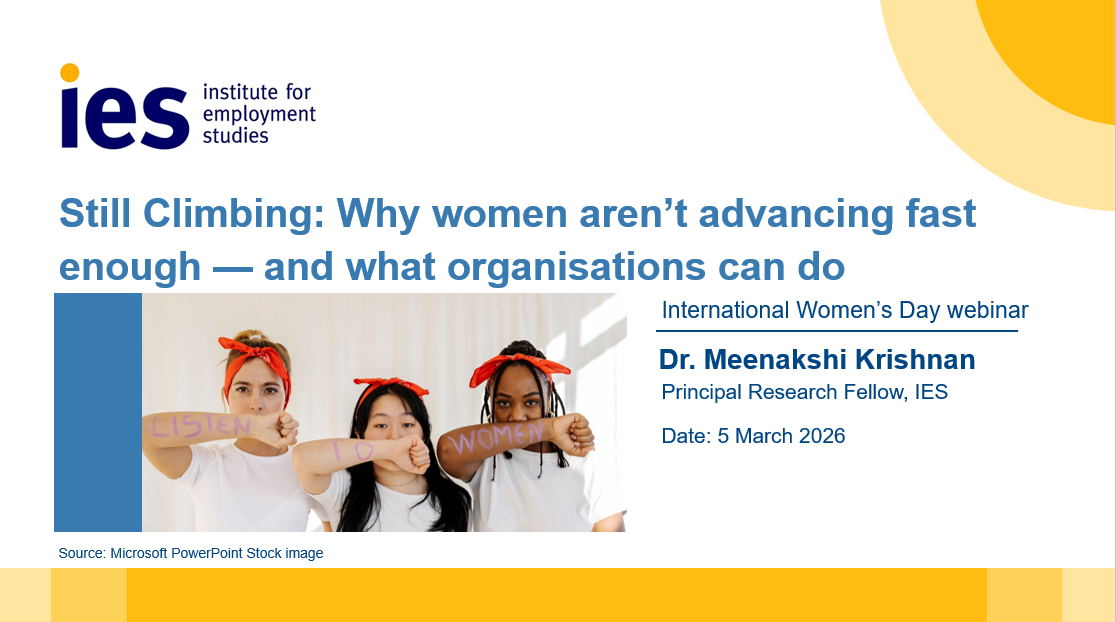
Webinar recording & slides: Still Climbing: Why women aren’t advancing enough, and what organisations can do next
In this public webinar to mark International Women’s Day, Dr Meenakshi Krishnan discusses the wide range of factors leading to the slow progress in improving gender equality in the workplace, and the changes organisations can make to help accelerate this. The webinar was chaired by Naomi Clayton, IES Chief Executive.
Background
Despite record gains for women on UK boards, progress into senior leadership roles remains stubbornly slow. Women now enter the workforce in large numbers and make up strong mid‑career pipelines, yet far too few advance into executive roles, CEO positions or other influential posts.
Event details
This webinar unpacks the real reasons behind this stalled momentum, from structural and cultural barriers to the lifecycle factors that disproportionately affect women’s careers, including caring responsibilities, burnout risks, and the growing conversation around menopause and work. Drawing on the latest evidence, we explore why the “broken rung,” “glass ceiling,” “leaky pipeline,” and “care/er cliff” persist and what sits beneath the gaps between women’s aspirations and actual progression. But this session doesn’t stop at diagnosing the problems. It turns evidence and insight into action, outlining what employers can do to create leadership pathways where women genuinely thrive.
Aligned with the International Women’s Day 2026 theme of Give to Gain, this webinar invited employers and leaders to reflect on how giving – through inclusive policies, supportive cultures, mentoring, and equitable opportunities ultimately multiplies impact across workplaces. Integrating perspectives from feminist praxis, including the inner narratives that shape confidence, identity and voice, this webinar offered a nuanced, realistic and forward‑looking view of how to accelerate women’s leadership and why the next decade must be one of intentional organisational change.
Topics covered:
- The leadership gap today
- Structural, cultural, and lifecycle barriers
- Inner conversations holding women back
- Closing the gap
- Q&A and discussion on practical challenges and experiences