
Featured

National Inclusion Week: can we build trust without agreeing?
Can organisations build trust and collaboration among people who do not share the same beliefs and values?
We publish blogs to provide insights from, and stimulate debate about, the latest research and thinking. Any views expressed are those of the author and not necessarily those of the Institute as a whole.
Featured
Can organisations build trust and collaboration among people who do not share the same beliefs and values?
Featured
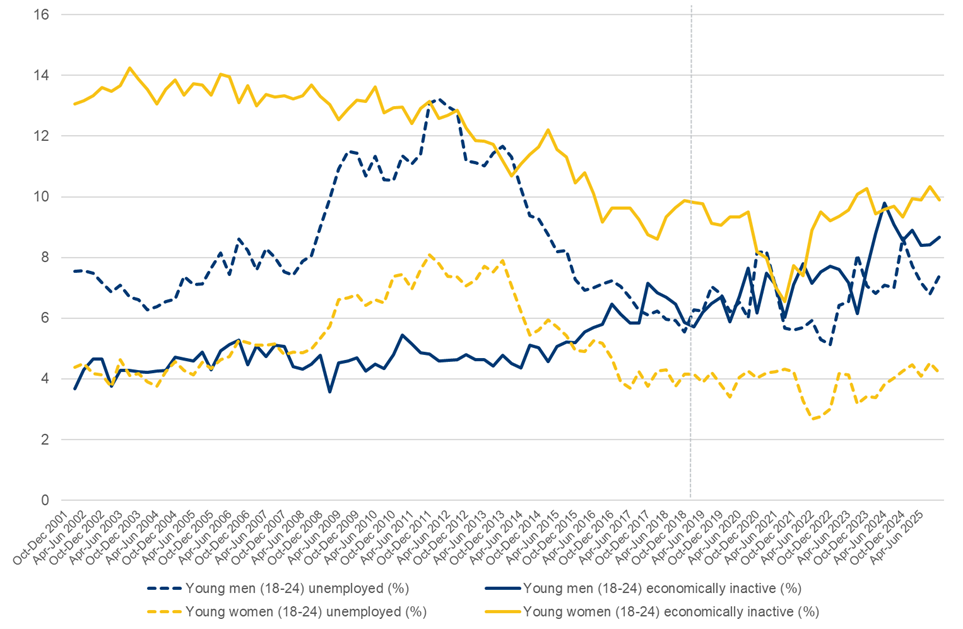
The UK labour market has remained flat with little movement in the headline employment, unemployment and inactivity rates over the last quarter.
Alison Carter reflects on how organisations can work with employees and develop team relationships to successfully respond to change, particularly relevant in the current fast-changing social and economic climate.
In the light of the House of Lords’ inquiry, Astrid Allen explores the continuing trend of home and hybrid working following the COVID-19 lockdowns, the comparable benefits of at-home and in-office working, and approaches to achieving the right balance moving forward.
IES analysis of this month's Labour Market Statistics, published July 17th 2025.
Emily Kramers and Rosie Gloster reflect on newly published research by ReAct on the Restart Prime Provider Network, a collaboration of prime providers for the Restart programme, which offers tailored support to individuals who are out of work for six months or more.
As National Employability Week 2025 starts, Dan Mason and Jade Talbot explore the long term impact of the recently announced expansion of free school meal provision for primary-age children on their future employment prospects.
In the second blog of this series on neurodiversity in the workplace, Claudia Plowden Roberts and Joseph Cook discuss the benefits of neuroinclusion to organisations, and explore how employers can implement inclusion most successfully including high-profile business examples.
Following the European HR Directors’ Circle annual Forum, and in the light of the current political stagnation on previously agreed net zero targets, Duncan Brown explores the role of HR in the context of the critical relationship between climate risk and business risk.
Following the recent IES report on workforce inequalities in health and adult social care, Dr Meenakshi Krishnan and Claudia Plowden Roberts focus on the high prevalence of intersectional discrimination in the research findings, and how implementing Section 14 of the Equality Act could help to address this.
To mark National Employability Day, Rosie Gloster and Jonny Buzzeo consider the Government's 'Get Britian Working' plans, and detail the key lessons from previous efforts to improve employment rates which can be used most effectively to inform this latest initiative.
Nick Litsardopoulos examines the dual impact of the increases in UK National Insurance Contribution (NIC) and the National Minimum Wage on the UK job market, and the possible consequences for both those in and out of employment.