
Employee Engagement: A review of current thinking
This report brings clarity to the debate. Based on a systematic review of the literature on employee engagement and synthesising current thinking and evidence.
 Many of you will have heard of the ‘Engage for Success’ (EFS) movement, and may even be active participants. Born out of the 2008- 09 MacLeod Review into Employee Engagement[1], EFS has grown into a massive pro bono movement incorporating 700 practitioners (HR professionals and managers) and 300 gurus (academics and consultants).
IES has been actively involved in EFS throughout. We are represented on the guru steering group and have supplied and reviewed evidence for the EFS website, www.engageforsuccess.org, which is a valuable source of material and discussion on the engagement theme.
In November 2012, EFS ‘went live’ via a CEO breakfast (a large gathering of the UK’s most influential business leaders), a lead letter in The Times, the unveiling of the EFS website, and a major conference featuring such luminaries as Archie Norman and the Minister with responsibility for employee relations, Jo Swinson.
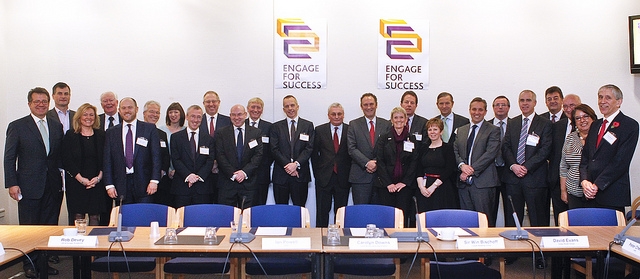
© Department for Business, Innovation and Skills.
At the EFS breakfast launch, CEOs from across the nation called on the UK to deliver £26bn GDP growth by better engaging employees.
The movement looks set to expand and involve ever-greater numbers of practitioners and experts.
Perhaps its biggest challenges are:
IES is helping with the last point by facilitating a special interest group (SIG) on the future of engagement (SIGs aim to provide challenge and thought-leadership via white papers for the website). If you have a view about the direction in which engagement is, or should be, heading, email [email protected] or tweet us @employmtstudies
[1] MacLeod, D. and Clarke, N. (2009), Engaging for Success: Enhancing Performance through Employee Engagement. Department for Business, Innovation and Skills. London.
Dilys Robinson has also written a chapter on the future of employee engagement for IES Perspectives on the HR Year Ahead 2013 report
IES has published several reports on the subject of employee engagement:
We will also be publishing two further reports later this year:
This report brings clarity to the debate. Based on a systematic review of the literature on employee engagement and synthesising current thinking and evidence.
This paper (published as ‘Reward and Engagement’, in WorldatWork Journal, November 2008) sets out the relationship between reward and employee engagement as a valid and powerful area for future research and practice in reward management. It considers what employee engagement really means and why it is important (primarily because of the potentially powerful influence on organisation performance). The paper presents a review of research evidence on the complex relationship between reward and engagement, and provides guidelines for practising a more engagement-focused approach.
Is your organisation losing its key people? Do you know why, and what might have persuaded them to stay? Are you confident that you can identify your key people and explain what makes them key? Do you know what motivates them, and why they might be looking elsewhere for job satisfaction? This paper aims to help you answer these questions and profiles different kinds of key people, for a practical and strategic approach.
Talent management continues to be high on employers’ agendas and over the previous year IES has both researched and advised in this area with organisations at varying stages of their talent management journey. This paper was also published as an article in IES Perspectives on HR 2014: HR responding to threats and opportunities.
This report is part of The Engaging Manager Series. Each short report in the Engaging Manager series explores different aspects of engaging management. This report explores the experiences and views of engaged teams, drawing on the findings from in-depth discussions with team members.
Engagement is a frequently used and fashionable term. Research into engagement, however, is almost non-existent. It appears that 'engagement' is not a recognised academic construct, yet all of us feel intuitively that we understand what it means. The work in this report is built on in 'Engagement: The Continuing Story', an IES report which tests our enagement measure and drivers tool in different settings and sectors.