
Journeys from learning to working: what support is there for marginalised young people?
15 Dec 2025

Billy Campbell, Research Fellow
In November 2025 youth unemployment rose to its highest levels since 2015, and NEET rates remained stubbornly high at over 12%, with around one in eight young people not in employment, education or training.
When explored in more detail, it’s evident that particular groups of young people experience greater disadvantage entering employment, education or training. For example:
- 25% of people with experience of the care system don’t move into employment within eight years of leaving secondary school;
- Individuals with mental ill-health are more likely to have lower educational attainment, and have employment rates between 25 and 39 percentage points lower than their peers;
- People with experience of the criminal justice system face discrimination in the early stages of the recruitment process, reducing application to outcome conversion rates among this group; and
- Those with special educational needs and/or disabilities are significantly less likely to be in work, and have lower earnings up to 15 years after Key Stage 4 than their peers.
The intersections between these groups also shouldn’t be overlooked. For example, those with experience of the care system are more likely to enter the criminal justice system than their peers, furthering the disadvantage they face moving into and between employment, education and training.
Uncovering the support that was available
Support systems are complex, fragmented, and are often difficult for service users, education providers, employers and service providers themselves to navigate. In an attempt to better understand this complexity, IES was commissioned by Youth Futures to map the support available to these four groups of young people.
To narrow the scope of the mapping exercise, support had to meet three key criteria: be at least in-part funded by national government; offer support towards transitions between education and employment; and be available in 2024 to people aged 14-30 in England.
Through searches of government department and community sector websites, a total of 80 individual, targeted support mechanisms available to the four groups were identified, as well as a range of ‘peripheral’ (i.e. housing and health) and ‘universal’ support mechanisms available to all young people. Support often targeted a particular life stage, be it: secondary education; post-16 education and training; transitions into employment; or employment.
Mapping the system
Now, don’t tune out, but… Have you ever travelled by train here in the UK and been delayed, experienced a last-minute service cancellation, maybe even used a rail replacement service, or just been outraged at the cost of a journey? If so, you might also consider rail travel as ‘complex’, or feel that there are fundamental improvements to be made to the UK’s rail system.
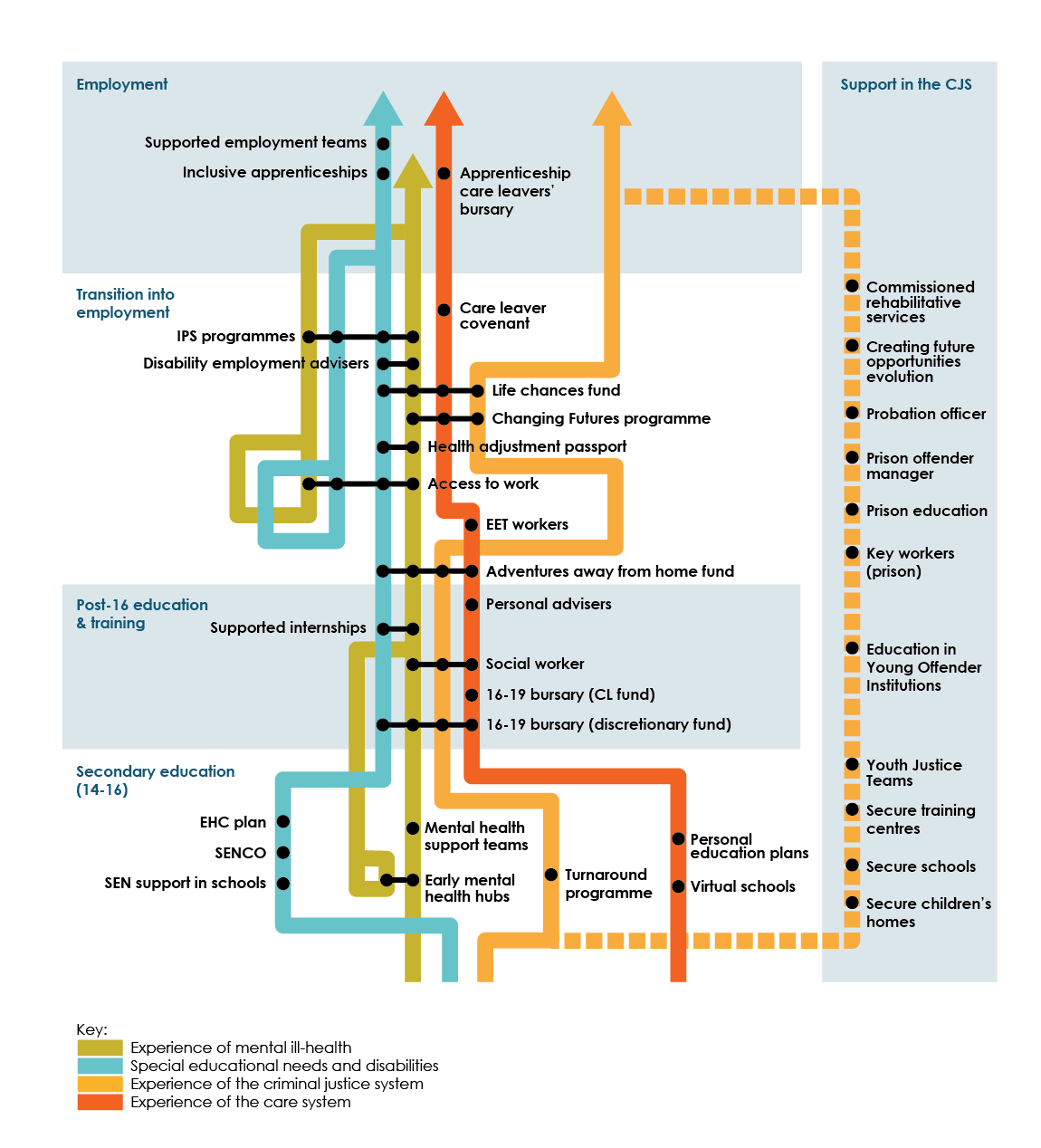
Confused? Well, back to it. We took this analogy and applied it to the support system young people are expected to navigate, often on their own and at a young age, to produce a visual representation of a young person’s journey from secondary education to employment in the style of a railway map.
Each group is represented by a ‘line’ that travels through the four life stages, or ‘zones’, passing through ‘stops’ that represent optional support available to them. In a few cases, like with IPS programmes, the line goes backwards – this is to say that this particular support is available in both life stages.
The dashed line, which is notably disconnected from the remaining support shows the journey for those serving custodial sentences (in secure schools/training centres or prison) who might not get to access many of the opportunities available to their peers serving suspended or community sentences. This is represented by a ‘branch line’, like you see on the Northern Line of the London Underground map.
While a real simplification of the journeys people take through adolescence and early adulthood, this visual highlights at which life stages support becomes scarcer, which groups are particularly underserved, or where there might be several similar support mechanisms that generate complexity and could be better connected.
Support available to four groups of young people that experience disadvantage as throughout EET
 Source: IES, 2025
Now we know lives aren’t like train journeys. They’re non-linear. People move from unemployment into employment and back into unemployment, and this just adds to the complexity people face in navigating the system. Take EET workers or Disability Employment Advisers for example, their support drops off once someone moves into work. Is it clear to a young person they can re-engage with that support?
So, while not a literal representation of the people’s support journeys, this infographic can act as a tool to open conversations about what’s working, what’s missing and where support can be better joined up to help people as they navigate the support system.
In our recently published report we present standalone versions of this railway map for each of the four groups of focus, and take a more detailed look at how this targeted support interacts with other peripheral and universal support. The report can be found here.
What’s next?
The scarring effect of unemployment in early adulthood on future prospects is well researched, and the recently published Mayfield review estimates that worklessness at a young age can result in over £1million in lost earnings across an individual’s life.
With this in mind, the government’s recent announcements of an independent review into youth inactivity and an £820m funding package for youth employment support are welcome. Alongside, in hope that they will successfully pull together fragmented local systems, there’s lots to learn from the ongoing Youth Trailblazer evaluations on how to drive system-wide change to better support vulnerable groups to access both, meaningful support and better opportunities.
Most importantly, the voice of young people experiencing the challenges that come with navigating this complex system needs to be amplified to ensure any change is meaningful, and directly targets their needs.
Any views expressed are those of the author and not necessarily those of the Institute as a whole.
| Category | Blog posts |
|---|---|
| IES contact |
 Billy Campbell Billy Campbell
|

